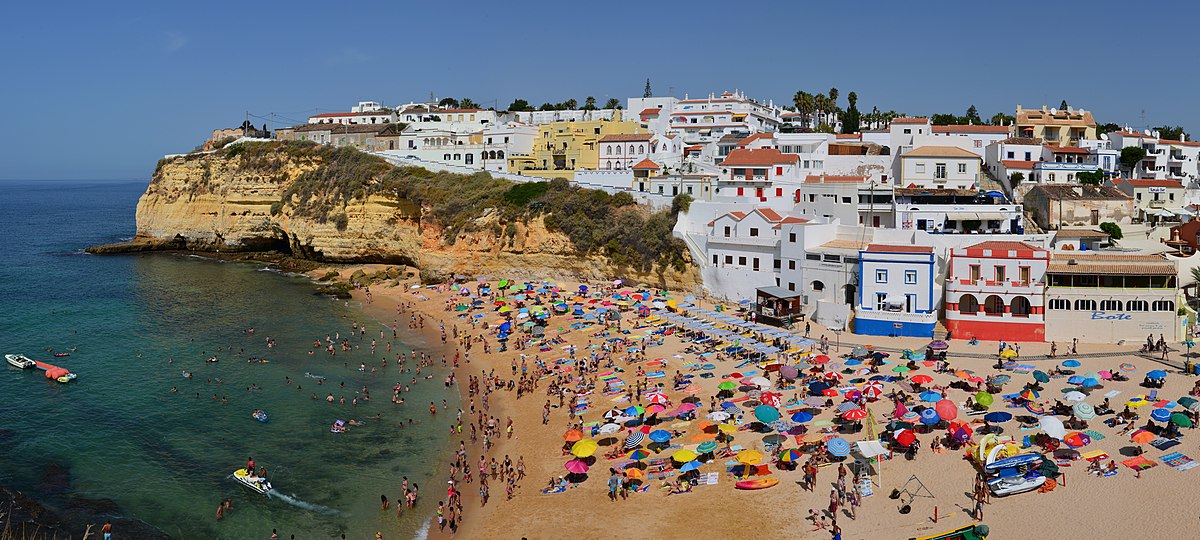
I have a theory about Carvoeiro that I’ve never been able to prove but strongly believe, which is that whoever first built this town picked the single most photogenic cove on the entire Algarve coastline and said “right, this is the one,” because the main beach sits inside a near-perfect crescent of golden cliffs like a theatre stage with the Atlantic as the backdrop, and when you stand at the top of the steps looking down at it for the first time – the coloured fishing boats on the sand, the whitewashed houses climbing the hillside on both flanks, the water so clear you can count the fish from thirty metres away – it genuinely looks like someone photoshopped a Portuguese village into a postcard and forgot to tone down the saturation. I was sceptical about it before my first visit because places that look that good in photographs rarely hold up in person, and then I arrived on a Tuesday morning in late May, parked at the top of town because parking anywhere closer seemed physically impossible even in the off-season, walked down through the narrow streets past a cat sleeping on a doorstep and a woman hanging towels from a balcony, turned the corner at the bottom and saw the cove opening up below me, and understood immediately why everyone who comes here ends up staying longer than they planned.
Carvoeiro sits on the central Algarve coast about fifteen minutes west of Armação de Pêra and twenty minutes east of Portimão, in the municipality of Lagoa, and what makes it different from the bigger resort towns along this stretch – from the Albufeiras and Vilamouras of the world – is that it stayed small, not through some heroic act of urban planning but because the geography simply wouldn’t allow anything else: the town is hemmed in by cliffs on three sides and there’s only so much you can build on a hillside before gravity and common sense intervene, which means you get a handful of streets, a compact square, a beach, and a web of staircases connecting it all together rather than the sprawling concrete that happened further east.
The Beaches Around Carvoeiro
The irony of Carvoeiro is that its main beach – the one in all the photographs, the one that made the town famous – is probably the least interesting beach in the area, which sounds harsh but stay with me. Praia do Carvoeiro is small, sheltered, and undeniably pretty, wedged between two cliff walls with calm water that turns turquoise on a sunny day, and it has lifeguards in summer and a row of restaurants along the promenade where you can eat grilled fish while watching the sea, but it fills up by ten in the morning during July and August in a way that makes lying down a competitive sport, and the really remarkable beaches – the ones that make this stretch of coast arguably the most spectacular in southern Europe – are all within a twenty-minute drive in either direction.
Praia de Vale Centeanes
My favourite approach to Carvoeiro’s beach scene is to skip the main cove entirely and head straight to Vale Centeanes, a five-minute drive east of town or about twenty minutes on foot if you take the coastal path, where the sand is wider than the main beach, the cliffs are more dramatic, there’s a decent bar-restaurant called O Stop that does cold beer and toasties without any pretension whatsoever, and – this is the important part – it’s the starting point of the Seven Hanging Valleys Trail, which I’ll get to in a moment because it deserves its own section. Blue Flag, lifeguards in summer, and a wheelchair-accessible ramp alongside the stairs, which is more than most Algarve beaches can say.
Praia de Benagil
Benagil has become one of those places that Instagram turned into a phenomenon, and I have complicated feelings about this because the Benagil Cave – a sea cave with a collapsed roof that lets sunlight pour in like a cathedral skylight onto a small internal beach – is genuinely one of the most extraordinary things I’ve seen on any coastline anywhere, but the fame has brought consequences. The beach itself is small, about 320 metres of sand fifteen minutes by car from Carvoeiro, reached via a steep path from the car park above, and as of 2026 you can no longer swim to the cave independently or paddle there on your own kayak: the authorities now require guided boat or kayak tours only, which run from both Benagil beach and Carvoeiro at around €20–30 per person for a ninety-minute trip. I understand the reasoning – people were drowning in the currents, the cave was getting damaged, the whole thing was becoming unsafe – but it does mean you need to plan the visit rather than just turning up with a pair of goggles and swimming out there, which is how I first did it years ago and which was, I’ll admit, considerably more thrilling.
Praia da Marinha
If Benagil is the Instagram beach, Praia da Marinha is the one that actually wins the awards, consistently ranked among the most beautiful beaches in Europe by people who rank beaches for a living, and having been there probably eight times now I’d say they’re right. It sits about seven kilometres east of Carvoeiro, accessed from a large car park at the top of the cliff – arrive before nine in peak season or don’t bother because the car park fills completely – with a long staircase down to the sand that has rest stops along the way for anyone who needs them, which on the way back up includes most people. The rock formations here are absurd, arches and sea stacks and pinnacles that look like they were designed by an architect having a very good day, and the water is clear enough to snorkel straight off the beach without needing a boat. You can also reach Marinha on foot via the Seven Hanging Valleys Trail from Carvoeiro, which is the better way to arrive if you have the legs for it.
Praia de Albandeira
Smaller, quieter, harder to reach, and worth the effort – Albandeira is only about eighty metres of sand squeezed between rocks, with a natural arch just offshore that you can walk through at low tide via a small tunnel in the cliff, and a pizza oven attached to the little beach bar that seems incongruous until you eat one of the pizzas and decide it makes perfect sense. No lifeguard, limited parking, wooden steps down that might give nervous people pause, and exactly the kind of beach you feel slightly smug about finding even though it’s on every Algarve blog in existence.
Algar Seco and the Boardwalk
If you only do one thing in Carvoeiro that doesn’t involve lying on a beach, make it this. Algar Seco is a headland about ten minutes’ walk east of the town centre where four hundred million years of geological patience have carved the limestone into something that looks like a collaboration between Gaudí and the sea – tunnels, passages, grottos, a towering pinnacle, and a natural formation called A Boneca (the Doll) where a short passageway opens into a small cave with two window-like holes framing the Atlantic in a way that would be annoying if a hotel charged you for the view.
You reach it via the Carvoeiro Boardwalk, a 570-metre wooden walkway that runs along the clifftop from the chapel of Nossa Senhora da Encarnação, free to walk, open all hours, and at sunset one of the most beautiful short walks I’ve taken in Portugal, which is saying something because the competition is fierce. At the end of the boardwalk, perched on the rocks above the formations, sits Boneca Bar, family-run since 1969, where the sangria is white and cold and the grilled fish comes off charcoal with the kind of smoky flavour that fancy restaurants try to replicate with expensive equipment and never quite manage – get an outside table if you can and sit there until the sun goes down, which is what everyone does and which never stops being good.
Walking the Seven Hanging Valleys
The Percurso dos Sete Vales Suspensos is a six-kilometre trail that runs along the clifftops from Vale Centeanes to Praia da Marinha, passing seven valleys that drop dramatically to the sea below, and it is without exaggeration one of the best coastal walks in Europe – I’ve done sections of the Camino, the Cinque Terre paths, the cliffs of Moher walk in Ireland, and this is up there with any of them, partly because of the views and partly because you can stop halfway through and get a beer, which the Irish cliffs conspicuously fail to offer.
The full out-and-back takes about five hours depending on how often you stop to photograph things, and you will stop often because around every headland there’s another cove more ridiculous than the last – you pass the Alfanzina Lighthouse standing white against the blue, then Praia do Carvalho accessible via a hand-dug tunnel through the rock, then the cliffs above Benagil where you can peer down at the cave from above, then the double sea arch at Arcos Naturais, and finally Praia da Marinha spread out below you like a reward. Bring water, wear proper shoes rather than flip-flops – I saw a man in hotel slippers attempting it once and his expression told the whole story – and start early in summer because there’s almost no shade along the route.
Things to Do in Carvoeiro
Boat Trips from the Beach
Several companies run tours directly from Praia do Carvoeiro, and the standard route heads east along the coast past Algar Seco, through a string of sea caves and grottoes, past Benagil Cave – where the boat enters if the swell is right – and continues to the arches near Marinha before turning back, the whole thing lasting about ninety minutes and costing €20–30 per person with outfits like CarvoeiroCaves and Mare Nostrum. I’d recommend the morning trips because the light is better for the caves and the sea tends to be calmer, while the sunset tours are popular for obvious reasons but sometimes get cancelled if the Atlantic decides to be Atlantic.
The Old Town
I should be honest and say that Carvoeiro’s old town isn’t old in the way that Lagos or Tavira are old – there’s no medieval wall, no Moorish quarter, no grand church that took three centuries to build. What there is, instead, is a compact tangle of steep streets and stairways connecting the hilltop to the beach, lined with small shops and restaurants and the occasional gallery, with a square at the bottom where the fishing boats get pulled up on the sand and where on summer evenings there’s often live music drifting up from one of the cafés. The east side of the beach still has working fishermen who sell their catch directly, and on the right morning you can buy sardines so fresh they’re practically still offended about it.
Carvoeiro Restaurants
The restaurant situation in Carvoeiro is better than it has any right to be for a town this size, ranging from a Michelin-starred tasting menu to a man grilling sardines outside a bar for four euros, and I appreciate both ends of that spectrum for different reasons.
Bon Bon
Bon Bon sits in the hills above Carvoeiro in Sesmarias, in an unassuming villa that gives nothing away from the outside, and inside Chef Luis Mourão has held a Michelin star for over a decade with a modern take on Algarvian cooking that uses seasonal local ingredients in ways that occasionally made me close my eyes while eating, which I’m told is embarrassing but which I maintain is the correct response to very good food. The lunch menu runs three courses for about €105, the evening tasting is seven or nine courses from €115 to €155, and the wine pairing adds another €75–95, which sounds steep until you’re sitting on the terrace with a glass of something from the Douro and realise you’d pay twice that in London for half the quality. Reserve well in advance.
O Pátio
At the opposite end of things, O Pátio has been operating on the square since 1964 and does what a Portuguese fish restaurant should do, which is grill whatever came off the boat that morning and bring it to the table on a plate without much ceremony – the bream gets filleted in front of you, the sardines arrive smoking from the charcoal, and a main course costs €15–20, and I have eaten here enough times that the waiter now nods at me in a way that suggests recognition rather than mere customer service, which I choose to interpret as friendship.
Jota Lita
Family-run since 1988 by João (the “Jota”) and his sister Lita, this place on Estrada do Farol does a fish cataplana that arrives in a copper pot big enough to serve as a hat if circumstances required it, with garlic butter prawns as a starter that I would eat every day for the rest of my life if my cardiologist would allow it, and the portions are enormous enough that ordering a starter and a main is genuinely ambitious for one person. €20–25 per head with wine. Book ahead because the dining room is not large and they know it.
O Pescador at Benagil
O Pescador sits in a century-old house on the cliff above Benagil beach, and the combination of views and food is the kind of thing that makes you briefly consider selling your property back home and never leaving, with whatever the fishermen brought in that morning prepared simply and served on the terrace overlooking the sea. Garlic prawns run about €15, a full meal lands around €40–45 per person, and if I’m being critical the prices are higher than equivalent quality elsewhere along this coast, but then you look at the view and decide you don’t care. Closed Sundays, reservations strongly recommended.
Rei das Praias
Between Carvoeiro and Ferragudo on Praia dos Caneiros, Rei das Praias has been doing cataplana on the beach since 1976, which is an impressive run for any restaurant let alone one that has to deal with sand in the kitchen and the Atlantic occasionally getting ambitious with the tide. The cataplana de marisco for two is the thing to order, a copper pot full of clams, prawns, and enough broth to mop up with bread until you’re uncomfortable, at roughly €30 per person with wine. Closed Mondays outside of summer.
Budget Eating
For those days when you’ve spent the afternoon’s restaurant budget on boat trips and ice cream, Tiffany’s Bar does a three-course lunch for €9.50 that isn’t going to change your life but will keep you going until dinner, while Mamma’s has a daily special for €5.50 that usually involves some combination of meat, rice, and salad that a Portuguese grandmother would approve of, and along the Estrada do Farol there are enough takeaway and casual spots that you can eat well for under €15 without trying particularly hard.
How to Get to Carvoeiro
| From | Distance | Drive Time | Notes |
|---|---|---|---|
| Faro Airport | 63 km | 50 min | A22 motorway (tolled, ~€7) or free via EN125 |
| Portimão | 12 km | 15 min | Coastal road through Ferragudo |
| Albufeira | 35 km | 30 min | A22 then exit Lagoa |
| Lagos | 30 km | 30 min | EN125 or A22 |
| Lisbon | 270 km | 2h 45min | A2 south then A22 west |
There is no train station in Carvoeiro and the bus service exists in the way that most Algarve bus services exist, which is to say technically and with a schedule that rewards faith over planning – the 52 connects to Armação de Pêra and Portimão a few times a day and is fine if your itinerary has room for a bus that may or may not arrive within the published window. A car is not strictly necessary if you’re staying in the town centre and are happy with the main beach and the boardwalk, but for reaching Benagil, Marinha, Vale Centeanes, or anywhere else worth visiting on this coast, renting one is the obvious move.
From Faro Airport a private transfer runs about €65–70 for up to four people, which is reasonable given the distance, and car rental starts from €25–30 per day with the usual companies at the airport, though in summer the cheaper options disappear fast so booking ahead makes a difference – and if you’re renting, factor in that parking in Carvoeiro in August requires the patience of a saint and the turning circle of a moped, because the streets were designed for donkeys and nobody has since widened them.
Carvoeiro Compared to Other Towns
People ask me whether they should stay in Carvoeiro or Albufeira, which is like asking whether you’d rather eat at a small family-run restaurant or a food court – both serve a purpose but you know exactly which one you’re going to remember afterwards. Albufeira has more of everything: more beaches, more nightlife, more restaurants, more shops, more British pubs showing football on screens the size of garage doors, and if that sounds like what you want then it will deliver, but Carvoeiro trades quantity for something harder to quantify, a sense of scale and personality that Albufeira lost somewhere around the time they built the strip.
Lagos is the more interesting comparison because both towns are pretty, walkable, and attract a crowd that appreciates good food and nice beaches without needing a nightclub at two in the morning, but Lagos is a proper town with a population and a history and a nightlife scene that exists beyond summer, while Carvoeiro is a village that goes quiet from November through March in a way that some people find charming and others find unsettling. For a beach holiday with children, I’d pick Carvoeiro over Lagos every time because the main cove is sheltered and calm and the whole place feels manageable in a way that Lagos, with its bigger scale and busier streets, sometimes doesn’t.
If you’re interested in how the different parts of the coast compare, we wrote a guide to Alvor that covers the western end, and the general Algarve guides on our blog go into more detail on each area.
When to Visit Carvoeiro
I’ve been in every season and the place works year-round, just differently: late May and June are my pick because the weather has committed to summer but the European school holidays haven’t begun, so the trails are walkable without heatstroke, the restaurants haven’t shifted into tourist-volume mode, and the beach at Vale Centeanes has room to put a towel down without negotiating territory with four neighbouring families. September is lovely too – the water hits its peak temperature, the light softens in a way that makes everything look five years younger, and the boat tour operators seem visibly more relaxed once the August crush passes.
July and August are fine if you don’t mind crowds, and I say “fine” in the qualified sense of “the beaches are beautiful but you’ll share them with everyone who booked the same flight as you” – arrive early for parking, book restaurants in advance, and embrace the fact that the Seven Hanging Valleys will feel less like a nature walk and more like a procession. Winter is quiet in Carvoeiro, genuinely quiet, with many restaurants shutting until spring and the town feeling like a film set between takes, but the coastline is spectacular in the low winter light and the walks are actually better without the heat, so if you don’t need a beach holiday and are happy with a jacket and a cataplana by the fire, there are worse places to spend a week in January.
Planning a Stay in the Carvoeiro Area?
Our team manages holiday villas and apartments across the Algarve, from Carvoeiro and Lagoa to Albufeira and Vilamoura. Whether you need a family villa with a pool or a quiet apartment near the cliffs, we can help.
Get in TouchPlanning a stay in the Algarve?
Book direct with Monte Rentals and skip the booking fees: see holiday rentals in Albufeira. Or browse holiday apartments in Albufeira · villas with private pool.
Frequently asked questions
What can I combine on a first visit to Carvoeiro?
Choose the village and beach as your starting point, then add the boardwalk or Algar Seco according to the group's mobility and the day's conditions. Treat a longer coastal walk as a separate activity with its own preparation.
Should I choose accommodation in Carvoeiro only by distance to the sea?
Check the actual walking route, slopes, parking and access to meals and shops. A short distance on a map may not describe the easiest route for your group or the return trip at night.