Algarve Hidden Gems That Most Tourists Never Find
The Algarve welcomes millions of visitors every year and the vast majority concentrate on the same five or six spots along the coast, from Benagil Cave to Vilamoura marina, Praia da Rocha and the Albufeira strip. These are destinations that deserve a visit, absolutely, but they represent a very small fraction of what the region has to offer. After years of living here and exploring every corner of southern Portugal, I have put together a list of places that rarely appear in conventional guidebooks and that tend to leave a much deeper impression than the usual classics.
Cacela Velha — Probably the Most Beautiful Spot in the Algarve
Cacela Velha is a tiny village perched on a cliff on the eastern Algarve coast, with barely twenty houses, a small church, the remains of a fortress and a single restaurant with a terrace overlooking the sea. Below the cliff lies the Ria Formosa lagoon, and when the tide goes out a sandbar appears forming a warm, crystal-clear, shallow natural pool that feels like something out of the Caribbean, with the difference that a grilled sea bream here costs eight euros. I took my parents there last spring and my mother, who has a strong opinion on practically everything, stood in silence for several minutes just staring at the view, which says quite a lot about the effect this place has on people. It takes about 15 minutes to drive from the Spanish border, though in summer it is worth arriving early because the small car park at the entrance fills up before ten in the morning.
Alte — A Journey Back to the Portugal of Fifty Years Ago
Alte sits in the foothills north of Albufeira and genuinely feels like stepping back half a century, with cobbled streets so narrow you can touch both walls at once, whitewashed houses with the hand-painted chimneys that are an emblem of the Algarve, and fig trees growing out of cracks in the pavement. At the bottom of the village there is a natural spring called Fonte Pequena where the water collects into a free swimming hole surrounded by ancient trees, an extraordinary relief when the thermometer hits 38 degrees in July and the atmosphere fills with local families, children splashing around and someone’s grandmother sitting in the shade commenting on the heat. The best time to visit Alte is February, when the almond blossom covers the hills in white and pink and the village holds a small local festival that has not yet been discovered by organised tourist circuits.
Monchique and Caldas — The Mountain Side of the Algarve
The existence of mountains in the Algarve tends to surprise anyone who only knows the coastal strip, but the Serra de Monchique, about 30 minutes inland from Portimao, is an entirely different world. The temperature drops as you climb the road, and by the time you reach the town of Monchique at 450 metres the landscape of cork oaks, roadside stalls selling medronho and dense fresh greenery makes it feel like a different region of Portugal altogether. After several days on the sun-baked coast, the contrast is almost therapeutic.
While the town itself has its charm, the real discovery is Caldas de Monchique, a tiny hamlet tucked into a wooded valley and built around the thermal springs that the Romans already used two thousand years ago. The combination of a small historic spa, a stream, enormous old trees and a stillness that is difficult to put into words produces a sense of calm you can feel physically within minutes of sitting down. It is also worth driving up to Foia, the highest point in the Algarve at 902 metres, where the views on a clear day stretch all the way to the coast on both sides of the peninsula.
Culatra Island — Where Cars Do Not Exist
The Ria Formosa has several barrier islands and most tourists head to Ilha de Tavira because it is the best known, but Culatra offers a more authentic and far less crowded experience. It takes thirty minutes by ferry from Olhao and upon stepping off there are no cars and no proper roads, just sand streets leading to a fishing village of colourful houses, cats everywhere and a couple of restaurants whose menu depends entirely on what the boats brought in that morning. Walking south through the village and past the dunes brings you to Praia da Culatra, a beach that stretches as far as the eye can see and where on a Tuesday in June it is perfectly possible to count a dozen people on the entire stretch of sand. The neighbouring island of Armona is even quieter, though the ideal pace is one island per day followed by a long lunch back in Olhao. If visiting this part of the coast, Tavira deserves at least half a day as an essential stop.
Silves — When This Was the Capital
Long before Faro gained any importance and long before Lagos became what it is today, Silves was the capital of the Algarve under Moorish rule, a city larger than Lisbon at the time and a genuine centre of poetry and learning. It is hard to picture that splendour when walking through what is now a quiet riverside town whose biggest weekly event is the Saturday market, but the imposing red sandstone castle crowning the hill remains as a witness to that era. Walking the walls while gazing down at the orange groves stretching below and imagining this place eight hundred years ago when it was one of the most important cities in Iberia is one of the most evocative experiences the Algarve has to offer. The archaeological museum next door, built around a Moorish cistern, is surprisingly thorough.
Silves is also the place to head for authentic inland Algarve cooking, away from the overpriced seafood of the tourist zones. A piri-piri chicken at a family restaurant by the river or a cataplana prepared according to tradition demonstrate that Portuguese food does not need to be expensive to be excellent. In August the town hosts its Medieval Fair, an event where the entire village dresses in period costume and the streets fill with jousting, fire-breathing, roast boar and generous quantities of mead, a mix of rigorous historical recreation and popular celebration that works extraordinarily well.
Estoi Palace — What Is This Doing Here?
Just ten minutes north of Faro stands a pink rococo palace with ornate gardens, azulejo-covered staircases and marble fountains that looks as though someone teleported a piece of the French Riviera into a Portuguese village and simply left it there. The gardens are free to visit and practically empty for most of the year, which adds an almost surreal quality to the experience. Right next door, literally on the adjacent plot, lie the Roman ruins of Milreu with their fish mosaics, thermal bath foundations and temple remains spanning roughly two thousand years of history. The two visits combined take no more than ninety minutes, cost nothing, and paired with a morning in Faro make up a full day that ninety-eight percent of tourists passing through the area never even consider.
The Seven Hanging Valleys Trail — The Best Walk in the Algarve
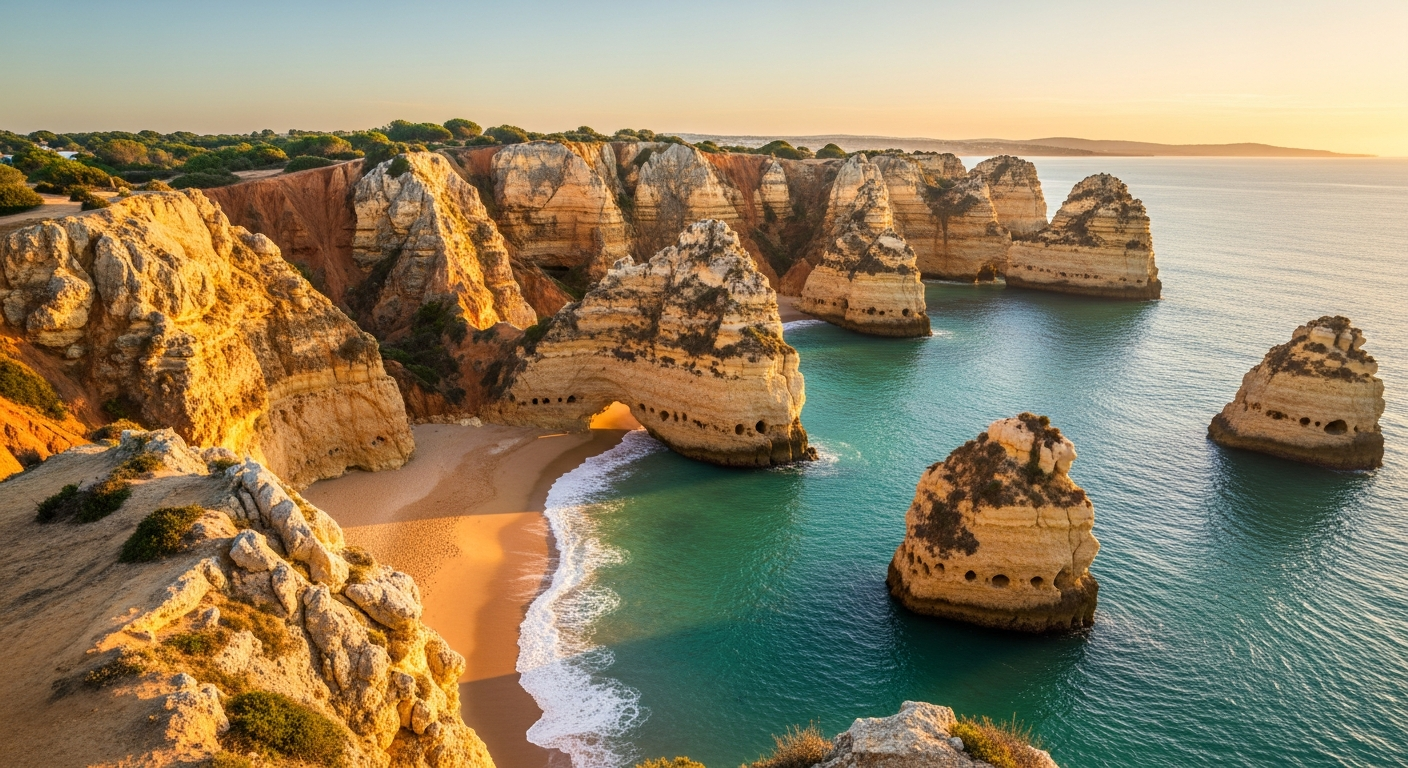
This 5.7-kilometre trail runs along the clifftops between Vale Centeanes and Praia da Marinha near Carvoeiro, passing natural rock arches, collapsed caves, hidden coves and carpets of wildflowers during the spring. After walking it roughly eight times there are still points where it is impossible not to stop and stare at the view. The difficulty is moderate and anyone used to walking can complete it without issue, but the complete absence of shade demands caution with timing during summer, the recommendation being to go before nine in the morning or after five in the afternoon, carry plenty of water and protect yourself from the sun. Praia da Marinha at the end of the route regularly features on lists of the best beaches in Europe with good reason, although the cliffs you walk past to reach it are arguably even more impressive than the beach itself.
Sagres — Where Europe Runs Out
The south-westernmost point of mainland Europe retains an atmosphere the Romans already considered sacred two thousand years ago, and standing at Cabo de Sao Vicente watching the Atlantic crash against seventy-five-metre cliffs with nothing but ocean between that spot and America makes it perfectly clear why they felt that way. The Sagres Fortress rises on a headland that juts into the sea like a stone fist, the place from which Henry the Navigator planned his great voyages of exploration and where a mysterious compass rose carved into the ground still survives with nobody able to fully explain its origins. The wind blows constantly, the landscape carries a raw elemental quality found nowhere else in the Algarve, and the nearby beaches of Tonel and Beliche offer some of the best surfing conditions on the entire Portuguese coast.
Loule Old Town — Beyond the Market
The Loule market with its red Moorish-inspired domes, fresh fish stalls and the lively Saturday gypsy market outside is one of the best-known attractions in the interior of the Algarve. What is surprising is that most visitors limit themselves to the market and leave without venturing into the old town that extends directly behind it, a neighbourhood of medieval castle walls, coppersmiths’ workshops that still operate using techniques unchanged for decades and streets with a feeling of genuine local life that the coastal strip lost a long time ago.
Ria Formosa Salt Pans at Sunset
More a moment than a destination in the conventional sense, the salt pans stretching between Olhao and Tavira offer one of the most memorable experiences in the Algarve during the hour before sunset, when the shallow water takes on shades of pink and gold and flamingos stand motionless in the lagoons like figures in a painting. The Quinta de Marim trails near Olhao are the simplest way to access this area where, besides flamingos, you can spot spoonbills, herons and numerous other water birds. Even for those with no particular interest in birdwatching, the quality of the light over the salt pans at that time of day is something truly extraordinary.
A Note on Getting Around
A car is essential for reaching these places, since the bus network connects the main towns but does not reach villages like Cacela Velha, does not climb the Serra de Monchique and does not stop at the trailhead for the Seven Hanging Valleys. The recommendation is not to try to cover too many spots in a single day, choose two destinations at most, leave time for a long lunch in between and accept that it is not possible to see everything in one trip. For those looking for a base that offers more than a hotel room, with an equipped kitchen, a terrace and enough space to properly unwind, we manage holiday rentals across the Algarve that make this kind of unhurried exploration of the region considerably easier.
Planning Your Algarve Getaway?
At Monte Rentals, we manage beautiful holiday properties across the Algarve. Whether you are looking for a quiet retreat near these hidden gems or a base to explore from, we can help you find the perfect stay.
Get in TouchPlanning a stay in the Algarve?
Book direct with Monte Rentals and skip the booking fees: see all our Algarve holiday rentals. Or browse holiday apartments in Albufeira · villas with private pool.
Frequently asked questions
How can I plan a quieter Algarve itinerary?
Choose a small number of inland villages or less central coastal stops and allow time to explore them. Check access and local conditions instead of assuming that a place described as a hidden gem will be empty.
Should I combine distant hidden gems in one day?
Group nearby places and choose one main area for the day. A shorter route leaves more time for walking and meals and reduces the risk of arriving after a small attraction has closed.