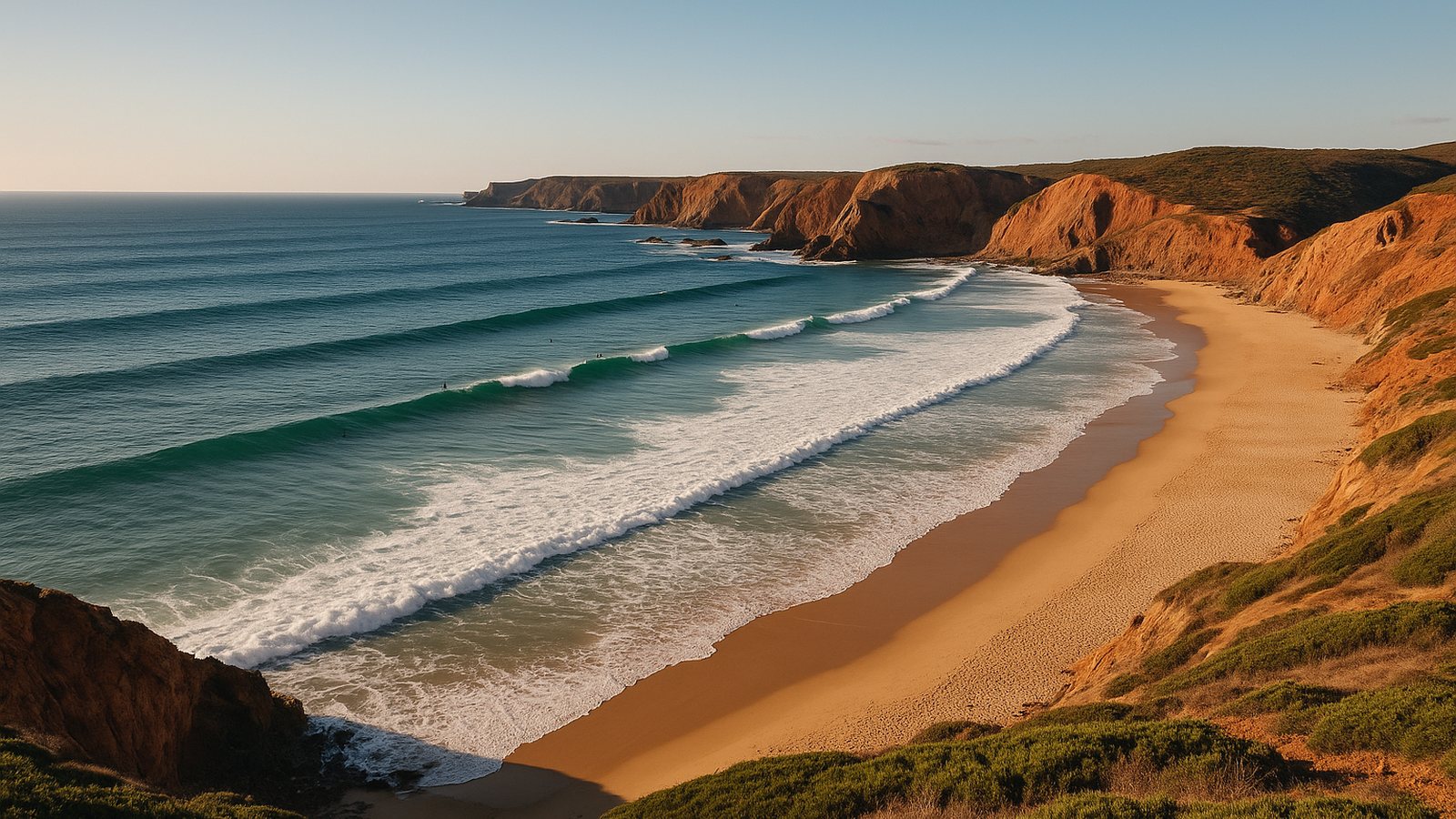
Most Algarve towns put their beach at the end of the street. Tavira does not have one. The sand sits offshore, on a chain of barrier islands inside the Ria Formosa lagoon, and the only way onto it is a boat or a footbridge. That single geographical fact explains almost everything visitors notice here — why the old town feels like a working Portuguese town rather than a resort, why nobody has built a promenade of bars along the water, and why the beaches empty out at the hour the last ferry leaves.
We manage holiday homes further west, in the central Algarve, and we send guests to Tavira constantly. This is what we tell them, with the fares and timings checked in August 2026.
The beaches are islands, and each one is reached differently
There are four realistic beach options from Tavira, and they are not interchangeable. The difference is the crossing.
| Beach | How you get there | Cost | Character |
|---|---|---|---|
| Praia de Tavira (Ilha de Tavira) | Ferry from Quatro Ãguas, 2 km from the centre | €2.00 return, adult | Full services, campsite, restaurants, busiest |
| Praia do Barril | Footbridge from Pedras d’El Rei (Santa Luzia), then 1 km on foot or by miniature train | Free on foot; a couple of euros on the train | Blue Flag, the anchor graveyard, wide open dunes |
| Terra Estreita | Ferry from Santa Luzia | Similar to the Tavira ferry | Quietest of the four, minimal facilities |
| Praia de Cabanas | Ferry from Cabanas de Tavira, 7 km east | Short hop, paid at the quay | Long sandbar, good for walking |
The Quatro Ãguas ferry, in numbers
The crossing to Ilha de Tavira takes a few minutes and costs less than a coffee. For August 2026 the operator lists €2.00 return or €1.20 one way for adults, €1.10 return or €0.65 one way for children aged 4 to 11, and free travel for under-fours. Boats leave Quatro Ãguas from 08:00, run at half-hourly intervals through the middle of the day, and the last regular sailing back from the island is at 20:00. On Saturdays in high season there are two extra late boats, around 21:30 and 22:00 from the island.
Tickets are sold at the quay, not online. Parking at Quatro Ãguas is paid and fills by mid-morning in August, which is the single most common thing that goes wrong for people driving out from a villa.
Praia do Barril and the anchor graveyard
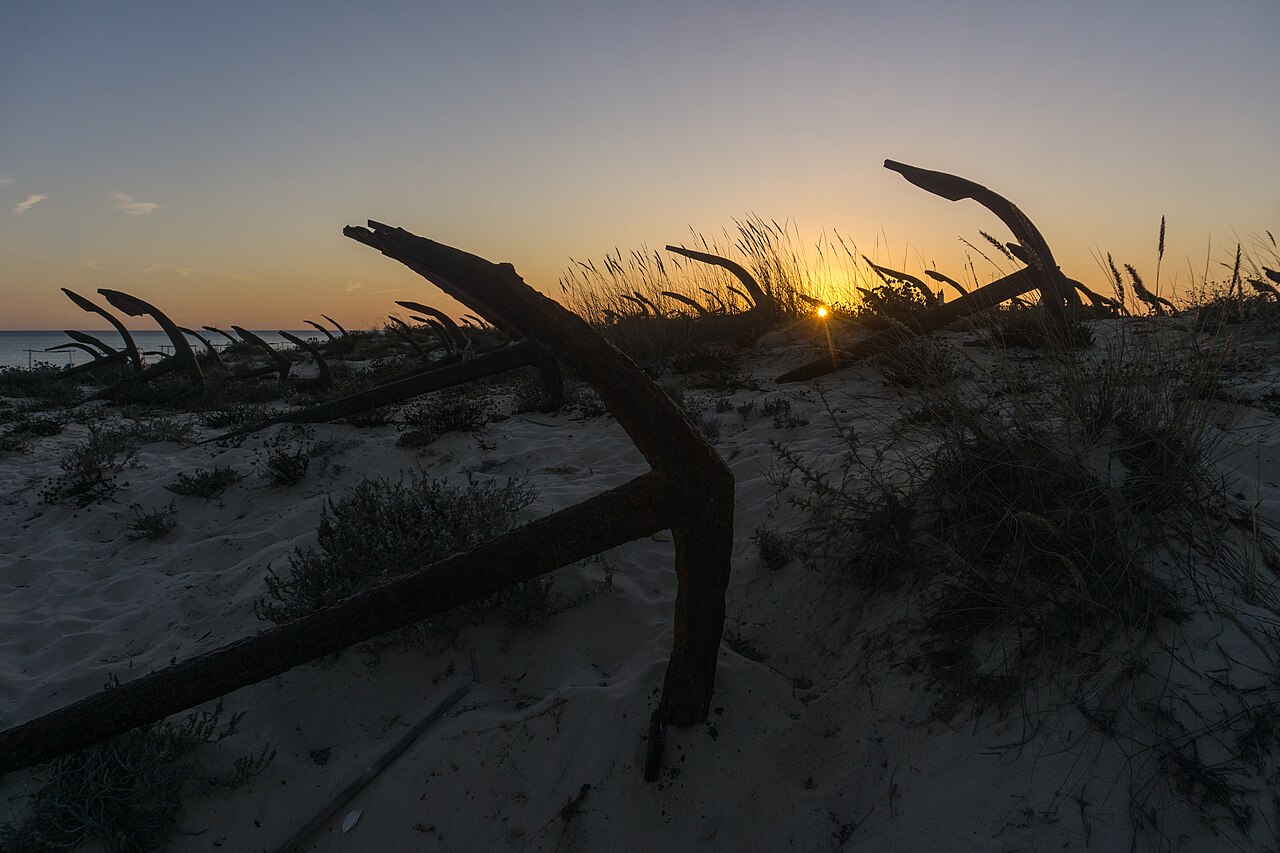
Barril is the one people photograph. You cross a pedestrian bridge over the Ria Formosa at Pedras d’El Rei, then cover about a kilometre either on foot along the old rail bed or on the little tourist train that runs the same route. Set into the dunes behind the beach are more than two hundred rusted anchors, laid out in rows. They are not decoration: they held the nets of the armação tuna traps, the labyrinths of netting that funnelled migrating bluefin into a killing chamber. The fishery collapsed when the tuna stopped coming, and the anchors were left where they lay.
Tavira council lists Barril as a Blue Flag beach and an officially accessible one, with reserved parking near Pedras d’El Rei, a wheelchair space on the train, adapted toilets and an amphibious chair for sea access on request (281 380 600). That combination — accessible and genuinely wild-looking — is rare in the Algarve.
Is Tavira worth it if you are staying in the central Algarve?
As a day trip, yes, but it is a real drive: roughly an hour and a quarter from Albufeira or Vilamoura on the A22. The alternative most people overlook is the train. The regional line along the coast connects Faro to Tavira in about 40 minutes, which turns the day into something you can do without a car and without worrying about the Quatro Ãguas car park.
What you are going for is a town that was rich before tourism existed and looks it. Tavira was a tuna and salt port, prosperous enough in the eighteenth century to ship salt, dried fish and wine out of the Gilão. The 1755 earthquake flattened much of it, and the rebuilding left a town with an implausible number of churches — the usual count is thirty-seven — inside a compact grid you can walk in an afternoon.
The bridge is not Roman
The seven-arched bridge over the Gilão is signposted and universally described as the Ponte Romana. Archaeological survey says otherwise: the structure is a twelfth-century Moorish bridge, later rebuilt, most recently after flood damage. It is a small thing, but it tells you how much of what circulates about Tavira is repeated rather than checked.
The camera obscura has awkward hours
Torre de Tavira houses a camera obscura that projects a live 360-degree image of the town onto a concave dish — the best orientation you will get in half an hour. Entry is €6.50 for adults, €6.00 for students and over-65s, €3.00 for children aged 4 to 12, and €18.00 for a family of four. The catch is the timetable: sessions run 11:00 to 14:00, Tuesday to Friday, with the last one at 13:30 and a maximum of fifteen people. If it is Saturday and you turn up at four, you have missed it. Weather can also close it, since it depends on daylight.
The salt pans are the other half of the landscape
West and east of the town, the Ria Formosa is divided into evaporation pans that still produce salt by hand. Workers called marnotos rake the crust through the summer and skim flor de sal, the fine crystal layer that forms on the surface, with wooden tools. In late summer some pans turn pink or orange, which is not a filter — it is Dunaliella salina, an alga that produces carotenoids as the brine concentrates.
The pans are also the best bird-watching in the eastern Algarve. Flamingos are present year-round and peak between November and March, alongside avocets, spoonbills, black-winged stilts and waders in numbers. Go within an hour of sunrise or sunset: better light, more activity, and no heat haze off the water.
When to come
| Period | What it is like |
|---|---|
| June to August | Every ferry full, parking at Quatro Ãguas gone by 10:00, sea around 22 °C. Go early or go late in the day. |
| September and October | The best trade-off. Warm sea, ferries still running a full timetable, town breathing again. |
| November to March | Reduced ferry service, flamingo season at its peak, restaurants shut on rotation. Bring a jacket for the evening. |
| April and May | Wildflowers on the dunes, cool water, everything open but nothing crowded. |
Practical notes people get wrong
- Quatro Ãguas is not walkable from the centre in August heat with beach kit. It is two kilometres with no shade for most of it.
- There is no shop on Ilha de Tavira worth relying on outside the restaurants. Take water.
- Santa Luzia bills itself as the octopus capital of Portugal, and it is where the pots are landed. It is a better lunch than the riverfront in Tavira, and cheaper.
- The last boat back is a hard deadline, not a guideline. Check the board at the quay when you arrive rather than trusting a schedule found online.
- Cabanas de Tavira has its own ferry and its own sandbar and gets a fraction of the attention. If Tavira feels busy, go seven kilometres east.
Frequently asked
Which is nicer, Tavira or Lagos?
They are opposites. Lagos has cliffs, coves and a nightlife economy; Tavira has flat sand islands, a lagoon and almost no nightlife. If you want to walk from your bed to a beach bar, Tavira will frustrate you. If you want a town that functions in February, Tavira wins easily.
Is a week in Tavira too long?
Not if you use it as a base for the eastern Algarve — Cacela Velha, Vila Real de Santo António, the Guadiana and Spain across the river are all within half an hour. A week spent only in the town itself would be slow.
Can you swim off the town?
No. The Gilão is tidal and there is no beach in Tavira itself. Every swim involves a crossing, which is exactly why the beaches stay as good as they are.
How much should we budget for the beach day?
Under €10 for two adults in transport. The cost of a Tavira beach day is parking and lunch, not access.
More of the same, further west
The east has the lagoon; the central and western Algarve hide their good places behind cliffs instead. We collected the ones our guests keep asking about in Algarve hidden gems that most tourists never find.
A local team for your Algarve property
We manage short-term rentals across the central Algarve, which means we spend as much time answering guest questions about ferries and beach access as we do on filings and turnovers. If you own a property here and want a straight answer about what it needs, browse our holiday homes in the central Algarve or get in touch with the team.

Monte Rentals Team
Built by owners, for owners. An international team managing short-term rentals across central Algarve, namely Armação de Pêra, Albufeira, Olhos de Ãgua, Vilamoura, Quarteira, Boliqueime, Porches, Loulé, Pera and Almancil, with hands-on experience navigating Portuguese regulation, local suppliers and the operational layer that breaks at scale.