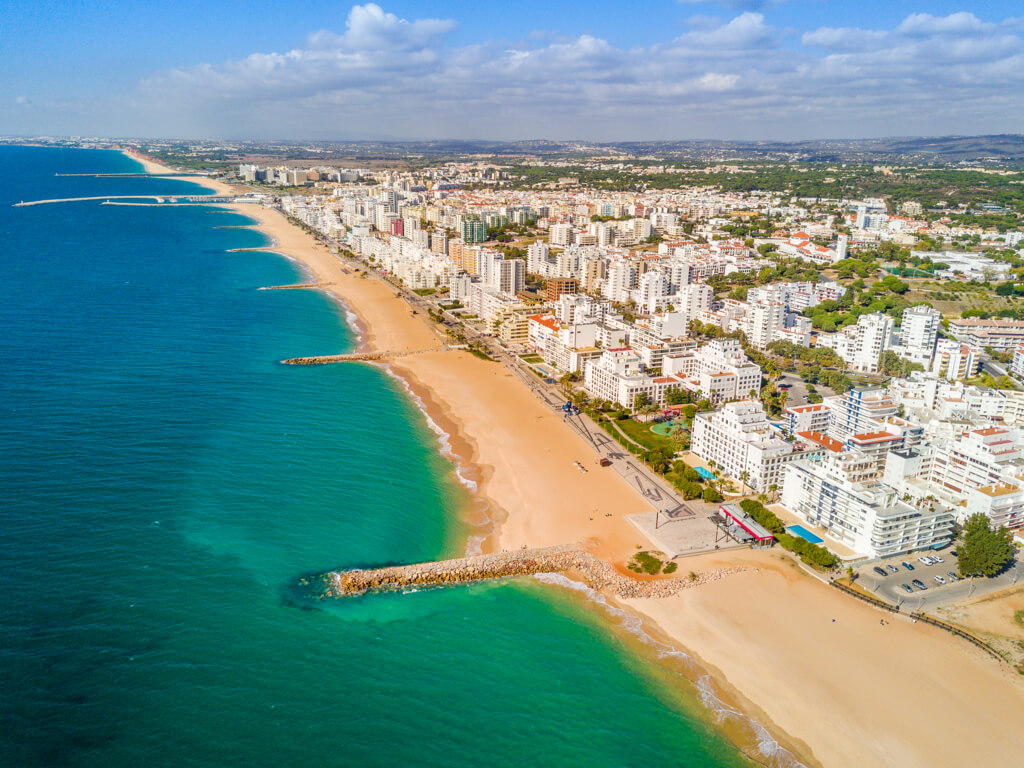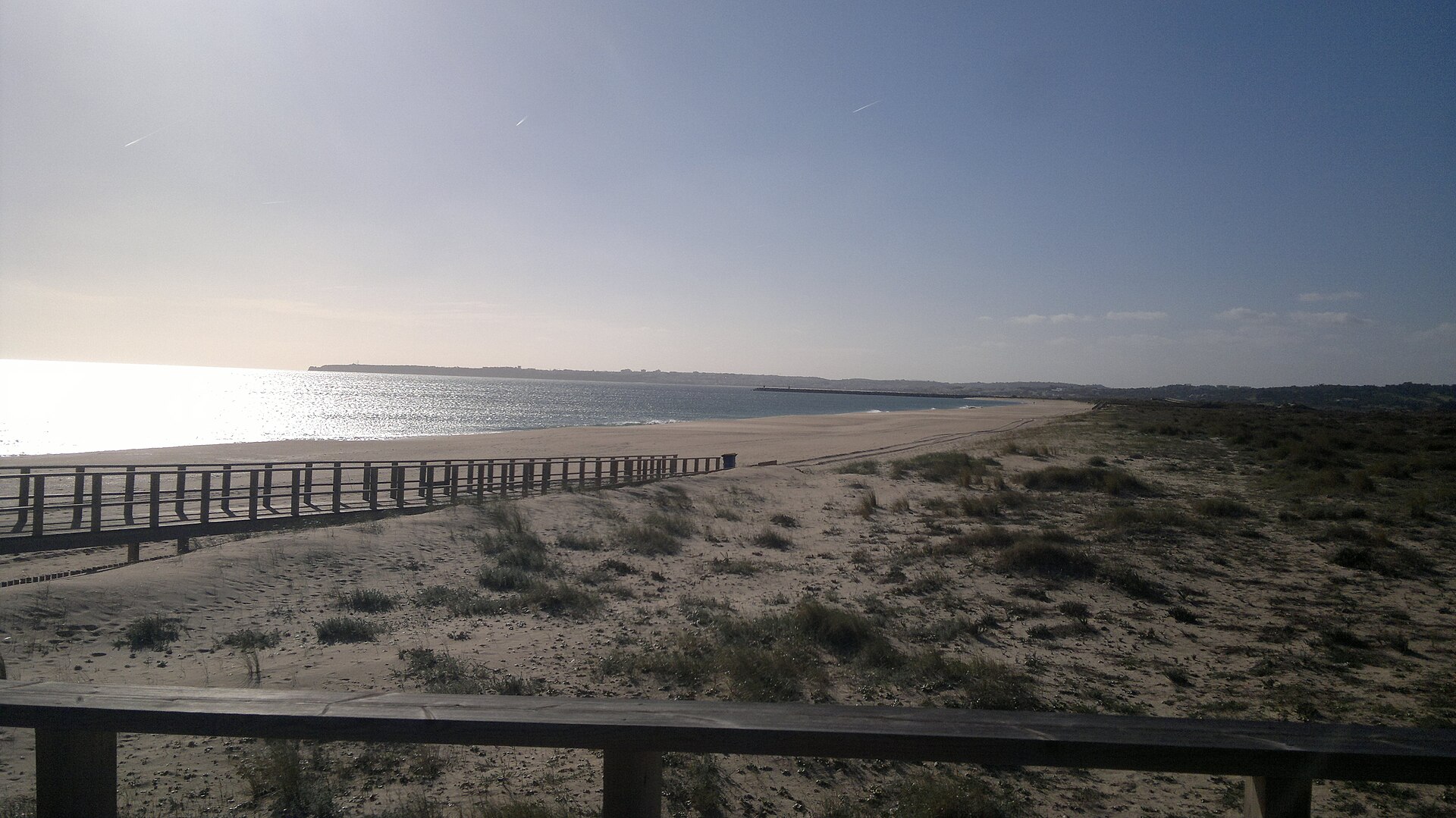
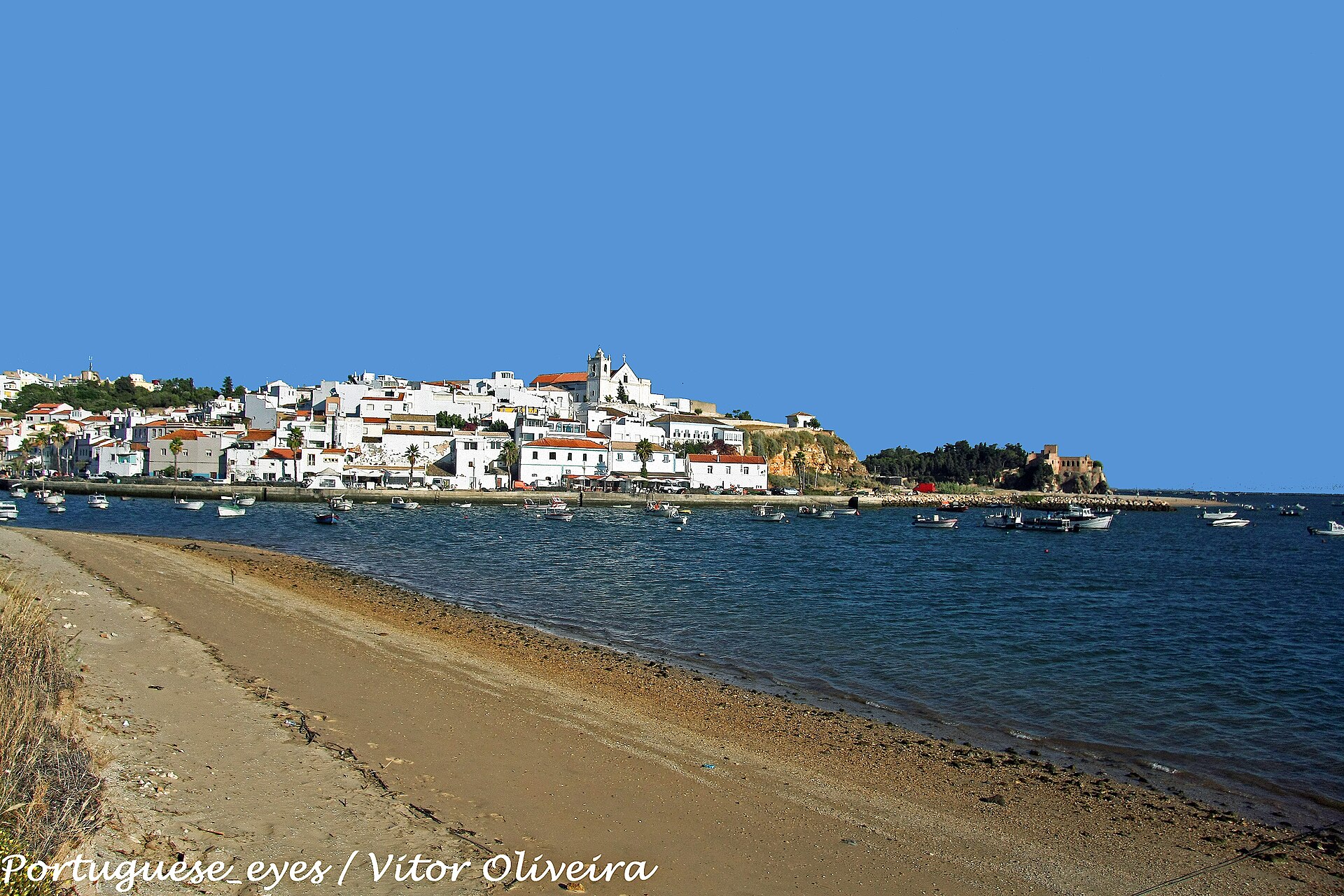
Stand on the seafront at Praia da Rocha and look across the mouth of the Arade. The white village climbing the far hill, under a castle that looks drawn for a children’s book, is Ferragudo, one of the few places in Portugal that the Algarve’s building boom left standing at its original height. It is barely a kilometre of water away from a wall of high-rise hotels, and it has none of them.
Almost everything written about Ferragudo calls it pretty and stops there. The more interesting question is why it is still like this, and the answer is a specific rule in a planning document, which is where we will start.
Why the village never grew tall
Ferragudo is a freguesia of Lagoa, and Lagoa’s master plan, published as Aviso 16179/2021, names it directly. Article 59 lists the central spaces of the municipality, “Lagoa, Carvoeiro, Ferragudo, Estômbar, Parchal, Mexilhoeira da Carregação e Porches”, and defines them as the old or historic cores of those settlements.
Article 59 also makes the central spaces of Ferragudo and Lagoa priority areas for urban rehabilitation, which points development at existing buildings rather than at new ones.
Article 62 is the one that shapes what you see. New building must respect the existing facade alignments and “the average facade height of the stretch between two cross streets”, and where there is no existing building or the average is lower, the maximum facade height is 7.5 metres. It adds that the massing and morphology of the surroundings must be observed. In plain terms, the height of the village sets the height of anything new, with a hard ceiling of two storeys.
The castle’s statutory protection zone adds a further constraint along the riverfront, and the coastal plan for the Burgau to Vilamoura stretch restricts new construction outside the traditional settlement perimeters.
Praia da Rocha, on the other bank, had no such regime when it grew upward from the 1960s. Two places, one river mouth, and a completely different outcome. That stretch of water is the shortest lesson in modern Algarve planning you can get in an afternoon.
A village, and how small is small
Be careful with population figures here, because the two available sources disagree. Lagoa council publishes 1,969 residents at the 2021 census. Citypopulation, compiling the same census data for the same territorial unit, gives 1,537. We could not resolve it against the INE tables directly, so treat it as the council’s figure of just under two thousand for the freguesia, with a smaller urban core.
The village covers about 5.74 square kilometres and was raised to the status of vila on 30 June 1999. Its charter is much older: Queen Leonor granted it on 21 August 1520, which is why the main square is the Praça Rainha Dona Leonor, and why the village celebrated 506 years in August 2026.
The castle you cannot visit, and the fort you can
The building everyone photographs is the Castelo de São João do Arade, and three things about it are routinely got wrong.
The date. It is not sixteenth century. After Portugal restored its independence in 1640, a fort was planned on the right bank of the Arade against Spanish attack, and the work was done between 1643 and 1644 on the site of an earlier fifteenth-century watchtower. The sixteenth-century date that circulates belongs to that tower, not to the fort. It survived the 1755 earthquake largely intact, being founded on solid rock.
The look. The fairytale silhouette is not seventeenth-century military architecture. The fort was decommissioned and sold in 1896. The writer and diplomat Joaquim José Coelho de Carvalho had leased it in 1892 and his family bought it, and the works carried out in the early twentieth century remodelled it in romantic taste. What you are photographing is a nineteenth-century idea of what a castle should look like, laid over a Restoration-era gun position.
The access. You cannot go in. It is a private residence and closed to the public. It has been classified as a Property of Public Interest since Decree 735/74 of 21 December 1974, but classification is not access. Photograph it from the Angrinha side or from the water.
Its opposite number is the Forte de Santa Catarina on the Praia da Rocha side, designed by the Italian military engineer Alessandro Massai, ordered in 1621 and completed in 1633. The two were built to cross their fire over the river mouth and protect the port. Santa Catarina is open and free, works as a viewpoint over the Arade and holds the small chapel of Santa Catarina. If you want to stand inside a fort and get the photograph looking back at Ferragudo, that is the one.
The beaches, and which are actually supervised
Ferragudo’s beaches are usually listed as if they were equivalent. They are not, and the difference is a matter of safety rather than taste. Two separate official lists decide it: the Blue Flag awards, and the Portaria 204-A/2026 that identifies bathing waters and sets the bathing season.
| Beach | Blue Flag 2026 | Official bathing water | Character |
|---|---|---|---|
| Praia Grande | Yes, listed as Ferragudo | Yes, PTCK9X, 1 Jun to 30 Sep | The village beach. Wide, calm, sheltered inside the river mouth. The family option. |
| Praia dos Caneiros | Yes | Yes, PTCL7Q, 1 Jun to 30 Sep | Ochre cliffs and a rock stack offshore, with a fish restaurant above the sand. The one people come back for. |
| Praia do Pintadinho | No | Yes, PTCJ8X, 1 Jun to 30 Sep | Small cliff cove, the local favourite, quieter than the other two. |
| Praia da Angrinha | No | Not identified | Estuary sand under the castle. Better for watching boats than for swimming. |
| Praia do Molhe | No | Not identified | South of the village, reached by steps. |
Read the middle column, not the first. A beach that is not an identified bathing water has no bathing season and no obligatory lifeguard cover at any point in the year, which is the case for Angrinha and Molhe. Pintadinho has a bathing season even though it does not carry a Blue Flag. The bathing season everywhere in Lagoa runs 1 June to 30 September, and outside those dates you should assume no supervision anywhere.
Lagoa municipality holds six Blue Flags in 2026 in total: Ferragudo, Caneiros, Carvoeiro, Vale de Centeanes, Senhora da Rocha and Vale do Olival.
One more thing that no guide mentions. None of Ferragudo’s beaches is on the Praia Acessível list. In Lagoa only Carvoeiro and Senhora da Rocha carry that accessibility designation. If anyone in your party has reduced mobility, plan around that.
Getting there without the usual mistakes
From Faro airport. There is no railway station at the airport, so the train is not a direct option: the nearest is Faro city, six kilometres away, reached by the Próximo line 16 urban bus in about twenty minutes. The alternative is the VAMUS line 56 AeroBus, which runs eight times a day from 1 May to 31 October but drops to only two departures a day per direction from 1 November to 30 April. If you land out of season, check that timetable before assuming you can get across the region by bus.
By train, and the trap in the name. The Ferragudo halt is not in Ferragudo. It sits in Parchal, about two kilometres from the village on foot, with a single platform and no facilities. The Algarve line was electrified in July 2026, so there are now direct services between Vila Real de Santo António and Lagos without changing at Faro, with roughly eighteen or nineteen trains a day each way. Fares are modest: Portimão to Ferragudo is €1.60, Faro to Ferragudo €6.65 on a Regional.
From Portimão by bus. VAMUS line 110 runs from Avenida Guanaré in Portimão to Rua Marechal Carmona in Ferragudo in about thirteen minutes, continuing to Caneiros and Lagoa. There are eight departures on a weekday and four at weekends and on public holidays, so it is usable but not frequent.
By water. The Taxi Ferry Ferragudo crosses to the Portimão riverside near the museum and the marina, and to Praia da Rocha. It runs roughly every half hour in summer, from mid-morning to late evening. It is a much better arrival than the road, and it sidesteps the parking problem entirely. Note that the marina is 2.4 kilometres from central Portimão.
Parking, and why we are being blunt about it
There are two main parking areas, the earth car park at Praia da Angrinha below the castle and a second on the north side of the river, plus the riverfront where the restaurants are. In July and August they are not enough, and the historic centre is largely pedestrian with steep cobbled lanes that you do not want to attempt in a car.
This is not a visitor’s grumble. In May 2026 the president of the Ferragudo parish council said publicly that parking in the village “is at a standstill” and called for a multi-storey car park to be built as soon as possible, mentioning a protocol with the marina concessionaire for around a hundred spaces at the village entrance.
The practical answer in high summer is to arrive before ten in the morning, or leave the car in Portimão and cross on the water taxi. Caneiros has free parking near the entrance but very few spaces, and it fills early.
When to go
The regional numbers explain the crowding better than any description. The Algarve recorded 3,233,700 overnight stays in August 2025 against 876,700 in November, roughly 3.7 times as many. In August the region accounts for 30.3 % of all hotel nights in Portugal, and bed occupancy hits 76.0 %, against 26.5 % in November. A village of around two thousand people absorbing its share of that behaves very differently in August than in May.
Here is the climate, from IPMA’s 1991-2020 normals at the Faro station. There is no climate station at Portimão, so Faro is the official reference for the region.
| Apr | May | Jun | Jul | Aug | Sep | Oct | Nov | |
|---|---|---|---|---|---|---|---|---|
| Average high | 20.7 °C | 23.5 | 26.8 | 29.4 | 29.2 | 26.4 | 23.3 | 19.6 |
| Average low | 12.4 °C | 15.0 | 17.8 | 19.6 | 19.9 | 18.3 | 15.8 | 11.9 |
| Rainfall | 39.0 mm | 26.2 | 5.1 | 0.9 | 3.0 | 21.5 | 56.0 | 75.5 |
| Days over 25 °C | 2.1 | 9.5 | 19.4 | 27.8 | 28.8 | 19.6 | 7.2 | 0.3 |
The recommendation that falls out of this is June or September. Both sit inside the Blue Flag season with lifeguards on the main beaches, both give you nineteen or twenty days above 25 degrees, and neither is August. October is warm and dry enough to be pleasant with the crowds gone, though the beaches are unsupervised from the first of the month. In winter the village is genuinely quiet and some restaurants close.
Eating in the village
Ferragudo’s reputation rests on grilled fish, and the concentration of restaurants around the Praça Rainha Dona Leonor and along the riverfront is high for a place this size.
- A Ria, Rua Infante Santo. Fresh fish, cataplana, arroz de tamboril. The strongest reviews in the village.
- Sueste, on the quay facing the Arade. Grilled fish, cataplana, xerém de berbigão. It reopened in April 2026 under new ownership with a new fish and shellfish menu.
- Rei das Praias, above the sand at Caneiros. Arroz de marisco and cataplana, and it marked fifty years in July 2026.
- Portarade, on the main square. Portuguese and Italian, with a set lunch at €9.50, €11.50 or €14.50 served from midday to five.
- Fim do Mundo, Rua Dr. Manuel Teixeira Gomes. Worth knowing that this one is a grill house rather than a fish restaurant, which surprises people who booked it expecting sardines.
Order what was landed that day rather than from the top of the menu, and in August book ahead. The square has a fixed number of tables and a great many more people wanting one.
The village festivals, and the one that is not Ferragudo’s
A correction first, because this trips people up every year. There is no Festa da Sardinha in Ferragudo. The sardine festival belongs to Portimão, across the river, and its thirtieth edition ran from 4 to 9 August 2026 on the Portimão riverside.
Ferragudo’s own festival is for Nossa Senhora da Conceição, and the main day is 15 August. Mass is at five in the afternoon and the procession leaves at six, accompanied by the Portimonense wind band. The floats are carried down to the lifeboat station, put aboard boats and taken out onto the Arade, then brought back ashore for the blessing of the boats and the fishermen before returning to the church. The parish council reported more than three thousand people at the 2026 edition. It is a village festa, not a tourist production.
Two more August dates: the anniversary of the 1520 charter, celebrated from 20 to 22 August 2026 with free entry and concerts in the lower village, and FATACIL in Lagoa itself, the region’s big craft and agriculture fair, from 21 to 30 August, at €5 a day with children under twelve free.
Common questions
Is Ferragudo worth visiting?
Yes, provided you want a village rather than a resort. There is a square, a church, a river, four beaches and an unusually good concentration of fish restaurants. If you want nightlife and a promenade of bars, that is Praia da Rocha across the water, which is exactly why the two work well on the same trip.
Is Ferragudo a walkable town?
The centre is, and largely pedestrian, but it climbs a hill on steep cobbled lanes. Praia Grande and Angrinha are an easy walk from the square. Pintadinho and Caneiros are not, and you will want a car or taxi for those. Nothing in the village is on the accessible beach programme.
What is the closest airport?
Faro, about an hour’s drive. Remember there is no station at the airport and the AeroBus drops to two departures a day between November and April.
Can you go inside the castle?
No, it is a private residence. The Forte de Santa Catarina across the river is open and free.
How long do you need?
Half a day covers the village, the square and Praia Grande. A full day with Caneiros and lunch. It works well as a base for a week, with Carvoeiro, Alvor and the Benagil coast all within half an hour.
For the contrast that makes Ferragudo make sense, spend an afternoon on the opposite bank. We have written about Praia da Rocha and how it became the beach that made the Algarve famous, the same river mouth and an entirely different idea of what a coast is for.
A local team for your Algarve property
We handle property management in the Algarve for owners across the centre of the region, and we spend a good deal of time in villages like this one on behalf of the people who own houses in them. If you have a property here and want it looked after properly, get in touch with the team.
Sources: planning rules from the Lagoa Plano Diretor Municipal, Aviso 16179/2021, Diário da República 2nd series no. 166 of 26 August 2021, articles 59 and 62. Blue Flag 2026 awards from ABAAE. Bathing waters and season from Portaria 204-A/2026/1. Castle classification from Decree 735/74; heritage records SIPA 2855 and DGPC 74742. Population from Câmara Municipal de Lagoa, 2021 census. Climate from IPMA normals 1991-2020, Faro station. Overnight stays and occupancy from INE. Rail fares from CP, tariff in force from 19 July 2026. Verified September 2026; timetables and opening hours change, so confirm before travelling.

Monte Rentals Team
Built by owners, for owners. An international team managing short-term rentals across central Algarve, namely Armação de Pêra, Albufeira, Olhos de Água, Vilamoura, Quarteira, Boliqueime, Porches, Loulé, Pera and Almancil, with hands-on experience navigating Portuguese regulation, local suppliers and the operational layer that breaks at scale.