Setting one nightly rate for the whole year feels tidy, but in the Algarve it nearly always costs money. A price low enough to fill your villa in November will be snapped up months ahead for August, while an August price leaves the calendar empty for most of the winter. A compromise somewhere in the middle tends to lose on both ends.
Dynamic pricing on Airbnb and the other platforms is the alternative: a nightly rate that moves with the season, local events, the day of the week and how far ahead guests are booking. It does not mean changing your price every morning. It means deciding in advance how your price should respond to demand, and then checking that it does.
What does dynamic pricing on Airbnb actually mean?
In practice it is a small set of rules built around a base price. You decide what a normal night is worth in each season, the lowest price you will accept, which dates deserve a premium and how to handle short gaps between bookings. The rate then rises when demand is strong and eases when it is weak, always within limits you have chosen.
There are three ways to run it. Airbnb’s own Smart Pricing adjusts your nightly price automatically between a minimum and a maximum that you set. Dedicated pricing software does a similar job across several channels once it is connected to your channel manager. Or you, or your property manager, set and review the rates by hand. All three can work, provided someone keeps an eye on the results.
How big is the Algarve’s seasonal swing?
Bigger than most owners expect. Statistics Portugal (INE) publishes monthly figures for the nights spent in the region’s tourist accommodation, and in its local accommodation category, the one that includes holiday lets, August 2026 recorded almost seven times as many nights as January 2026.
| Month | Nights | Compared with August 2026 |
|---|---|---|
| September 2025 | 248,551 | 73% |
| October 2025 | 176,558 | 52% |
| November 2025 | 78,674 | 23% |
| December 2025 | 57,020 | 17% |
| January 2026 | 50,559 | 15% |
| February 2026 | 66,802 | 20% |
| March 2026 | 103,716 | 30% |
| April 2026 | 163,385 | 48% |
| May 2026 | 199,685 | 59% |
| June 2026 | 227,565 | 67% |
| July 2026 | 294,228 | 86% |
| August 2026 | 340,588 | 100% |
Two things stand out. The fall after the summer is steep: October still reached about half of August’s level, but November dropped below a quarter of it. And the shoulder months are far from empty, since September 2025 was busier than June 2026, and April, May and June together came close to the July and August total.
INE’s figures cover the establishments in its monthly survey, so read them as the shape of regional demand rather than a forecast for your own property. For pricing, the shape is what matters: one rate cannot be right for a month at 15% of the peak and a month at 100%.
The price levers that make the biggest difference
- Seasonal base rates. Start with four or five bands rather than a single price: peak summer, the shoulder months on either side, autumn and winter, and the Christmas and New Year period. Each band gets its own base rate.
- Dates with their own demand. Events, school holidays and bank holiday weekends can lift demand for a few nights well above the season around them. Those dates deserve to be priced one by one.
- Booking window. If your peak weeks are fully booked six months ahead, the price was probably too low. In quieter months, a modest reduction close to the date can turn an empty night into income, as long as it stays above your minimum.
- Gap nights. A two-night gap between bookings rarely sells while your minimum stay is seven nights. Lowering the minimum stay, or the price, for that specific gap often fills it.
- Day of the week. Outside summer, Friday and Saturday nights can attract short breaks from Portugal and Spain, while Sunday to Thursday is quieter. On Airbnb, a separate weekend price requires Smart Pricing to be switched off.
- Length of stay. Weekly and monthly discounts reward longer winter stays. On Airbnb these discounts take precedence over Smart Pricing, so set them with that in mind.
Dates worth checking in your 2026–27 calendar
We confirmed these dates in official sources on 24 October 2026. Look at your calendar around each of them before a guest books one at your normal rate.
| Dates | What happens | Why it matters for your price |
|---|---|---|
| 20–22 November 2026 | MotoGP Grand Prix of Portugal at the Algarve International Circuit, Portimão | A race weekend in an otherwise quiet month |
| 24 December 2026 – 1 January 2027 | Christmas and New Year | Family stays and New Year breaks in the middle of the low season |
| 9 February 2027 | Carnival Tuesday | Carnival weekend celebrations in towns across Portugal |
| 26–29 March 2027 | Easter weekend, from Good Friday to Easter Monday in the UK | The first big spring break for British guests |
| 3 May and 31 May 2027 | UK early May and spring bank holidays | Long weekends from the UK |
| 30 August 2027 | UK summer bank holiday | A long weekend near the end of the summer holidays |
School holiday dates in the UK vary by local authority, so check the calendars that match where your guests usually come from. If your property attracts guests from Portugal or Spain, add their public holidays as well.
Smart Pricing, pricing software or a manager?
| Option | What you control | What to watch |
|---|---|---|
| Airbnb Smart Pricing | A minimum and a maximum price, with the option to set custom prices for individual nights | Weekly, monthly and trip-length discounts override it, weekend pricing needs it switched off, and it only prices your Airbnb listing. Airbnb may pause it temporarily to prevent extreme price changes. |
| Dedicated pricing software | Base price, minimum price, seasonal and event rules across the channels it is connected to | A paid subscription that still needs local knowledge and regular review |
| Manual pricing | Every rate on every night | Time-consuming, and easy to neglect during busy weeks |
| A property manager | Your goals and limits, agreed in advance | Ask how often rates are reviewed and which minimum price is applied |
Whichever route you choose, the tool only follows the rules it is given. The base price, the minimum and the event dates still need someone who knows the Algarve and knows your property.
How to set a minimum price you will not regret
The minimum price is the most important number in any dynamic pricing set-up, because it is the one protecting you in January. Work it out from your own costs rather than copying a neighbour’s listing.
- Add up the costs that come with every stay: cleaning, laundry, welcome supplies and the platform’s commission.
- Add the costs that grow with every night: electricity, water, gas and consumables.
- Decide what margin makes a booking worth the wear on your home.
As an illustration, if each stay costs €85 in cleaning and laundry and each night adds €15 in utilities and consumables, a two-night booking costs €115 before commission and margin. At €60 a night, that stay brings in only €5 before commission. A longer minimum stay or a higher floor for short winter bookings avoids the problem. These figures are examples, so use your own invoices.
Your minimum price is only one part of the picture. Our breakdown of holiday rental investment in the Algarve shows how pricing, occupancy and running costs work together across a full year.
Pricing mistakes we often see
- Discounting the summer too early. Cutting peak-week prices months in advance can give away nights that would have sold at the full rate.
- Copying last year’s calendar. Easter moves every year. In 2027 Good Friday falls on 26 March, so spring rates built around April will miss it.
- Forgetting the tourist tax. When we checked Airbnb’s page on tax collection in Portugal on 24 October 2026, it listed only Lisbon and Porto. Where your Algarve municipality charges a tourist tax, Airbnb does not collect it automatically, so agree how it is handled and leave it out when you compare nightly rates.
- Expecting existing bookings to change. On Airbnb, pricing changes do not affect pending or confirmed reservations. A new rate only applies to new bookings.
- Setting the rules and forgetting them. Any automated system needs a monthly check: are the busy dates booking too fast, and are the quiet ones moving at all?
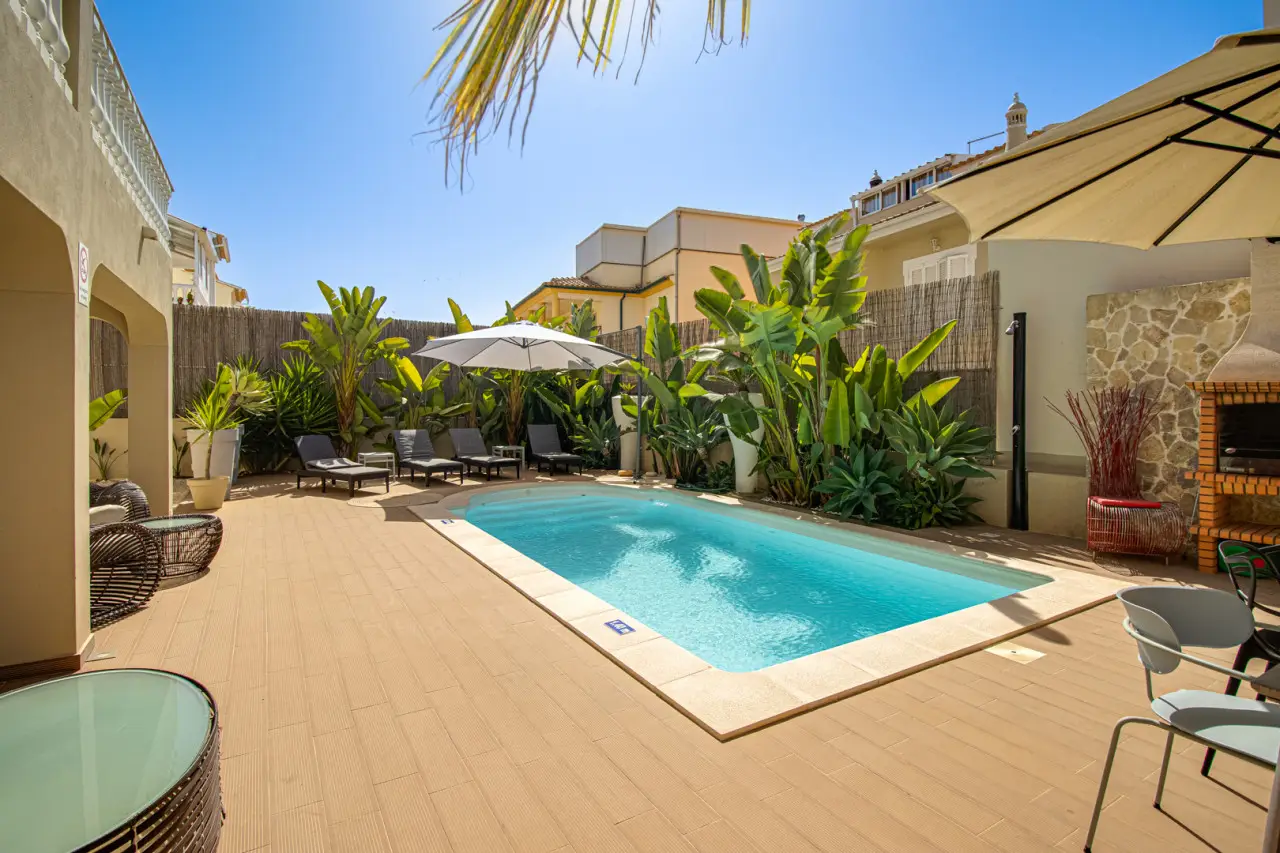
Featured image: villa with a private pool in Albufeira, photographed on 16 November 2016 by Kolforn, Wikimedia Commons, CC BY-SA 4.0, cropped.
A local team for your Algarve property
Find out how our property management Algarve service looks after holiday homes, or explore our algarve holiday rentals for your next stay.
Frequently asked questions
Does dynamic pricing mean changing my price every day?
No. It means setting rules in advance: seasonal base rates, a minimum price, event dates and what to do with short gaps between bookings. The rate moves when demand changes, and someone reviews the results regularly, at least monthly and more often around busy dates.
Should I just switch on Airbnb Smart Pricing?
It can be a reasonable start for a listing that is only on Airbnb. You must set a minimum and a maximum price, weekly, monthly and trip-length discounts override it, and a separate weekend price requires it to be switched off. If you also list on Booking.com or other channels, you need another way to keep those rates consistent.
How low should my winter price go?
Never below what a stay costs you. Add cleaning, laundry, platform commission and the nightly running costs, then the margin you need. If short winter stays fall below that level, raise the minimum stay rather than deepening the discount.
Do price changes affect bookings that are already confirmed?
Not on Airbnb. Its help centre states that pricing changes do not affect pending or confirmed reservations, so a new rate only applies to new bookings. Check the rules of any other platform you use.